
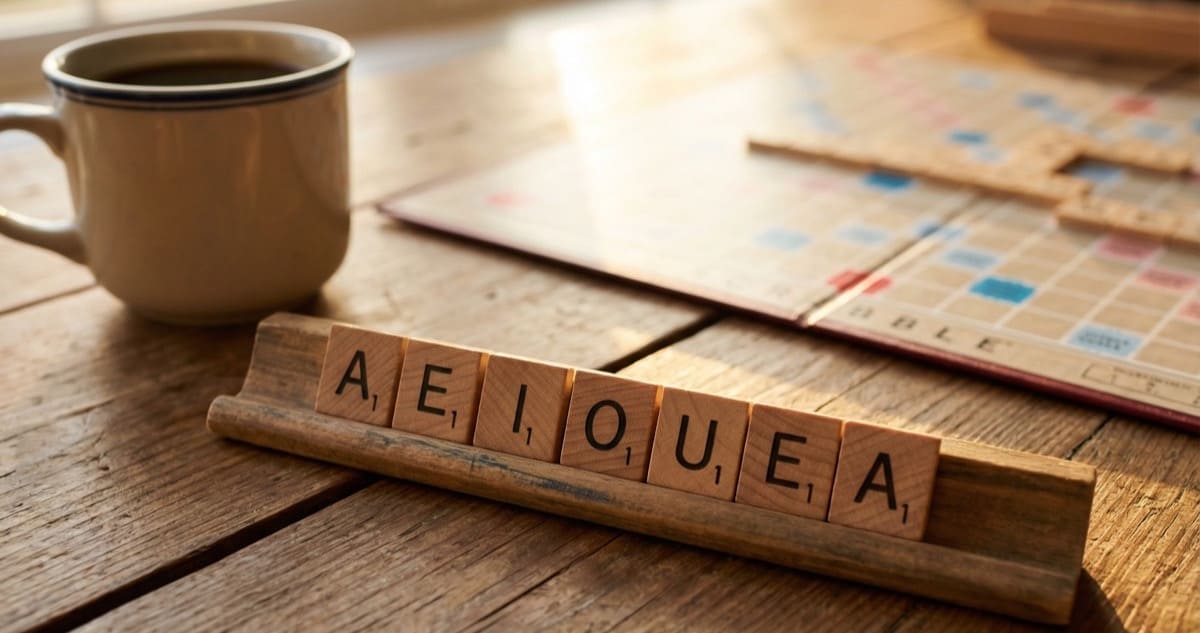
The Vowel Problem Every Player Faces
You glance at your rack: A, E, I, O, U, E, A. Seven tiles, five of them vowels, and two of them duplicates. Your opponent just played QUIRKY for 78 points and you're staring at what feels like a linguistic wasteland.
Sound familiar? It should. Vowels make up 42% of all tiles in a standard Scrabble set (42 out of 100). Drawing a vowel-heavy rack isn't bad luck. It's a mathematical certainty that'll happen multiple times per game.
I used to just stare at vowel-heavy racks and play the first 2-letter word I could find. Bad strategy. The key is knowing how to handle it intentionally rather than reactively.
Understanding Scrabble Tile Distribution
Before getting into strategies, it helps to understand exactly what you're working with. According to the official Scrabble tile distribution, a standard English-language set contains 100 tiles:
| Vowel | Count in Bag | Point Value | % of Total Tiles |
|---|---|---|---|
| A | 9 | 1 | 9% |
| E | 12 | 1 | 12% |
| I | 9 | 1 | 9% |
| O | 8 | 1 | 8% |
| U | 4 | 1 | 4% |
| Total Vowels | 42 | 42% |
Nearly half the tiles you draw will be vowels. The remaining 56 are consonants (plus 2 blanks). With 42 vowels in a 100-tile bag, the odds of drawing a vowel-heavy rack at some point are overwhelming. This isn't a flaw in the game. It's a deliberate design choice by Hasbro that rewards players who know how to manage their rack composition.
Notice that E is the most common tile with 12 copies. So E-heavy racks are the most frequent type of vowel overload you'll run into. Planning your strategy around E-dumping words is especially valuable.
Why Vowel-Heavy Racks Are Dangerous
The problem isn't that vowels are worthless (they're essential for building words). The problem is that most high-scoring words need a balanced mix of vowels and consonants. Looking at the Scrabble dictionary data:
- 62% of valid 7-letter words have exactly 3 vowels and 4 consonants
- Only 8% of 7-letter words have more vowels than consonants
- Words with 5+ vowels average just 8.2 points (before board bonuses)
A vowel-heavy rack means low scoring potential and almost zero chance of a bingo (50-point bonus).
That last stat really hit me. 8.2 points average. You're basically playing not to lose rather than playing to win.
The 3 Vowel Dumping Strategies
Strategy 1: The Quick Dump (Play Short Vowel-Heavy Words)
Use 2-3 letter words that consume vowels without wasting premium board positions. The best short vowel dumps:
| Word | Letters Used | Points | Valid In |
|---|---|---|---|
| AA | A, A | 2 | Scrabble US/UK, WWF |
| AE | A, E | 2 | Scrabble US/UK |
| AI | A, I | 2 | Scrabble US/UK, WWF |
| OE | O, E | 2 | Scrabble US/UK, WWF |
| OI | O, I | 2 | Scrabble UK only |
| EAU | E, A, U | 3 | Scrabble US/UK, WWF |
Check our complete 2-letter word list for all valid options across different dictionaries.
Strategy 2: The Value Dump (Score While Clearing)
Instead of just throwing vowels away, look for medium-length words that use multiple vowels AND score decently:
| Word | Vowels Used | Base Points |
|---|---|---|
| ADIEU | 4 (A, I, E, U) | 6 |
| AUDIO | 4 (A, U, I, O) | 6 |
| OURIE | 4 (O, U, I, E) | 5 |
| AERIE | 4 (A, E, I, E) | 5 |
| LOOIE | 4 (O, O, I, E) | 5 |
| QUEUE | 4 (U, E, U, E) | 14 |
Strategy 3: The Exchange (When Legal)
In Scrabble, you can exchange any number of tiles instead of playing a word, but you lose your turn entirely. This is a last resort, but it's sometimes the right play. Consider exchanging when:
- Your rack has 5 or more vowels
- The board doesn't allow decent vowel plays
- You're ahead by 50+ points (you can afford to lose a turn)
- There are still 7+ tiles remaining in the bag
Never exchange when fewer than 7 tiles remain in the bag. The rules don't allow it.
Advanced Vowel-Heavy Words
Knowing a wide arsenal of vowel-heavy words gives you way more flexibility during a game. I've organized these by vowel count. Memorize the 4-vowel ones first (they come up the most) and you'll never feel helpless with a vowel-loaded rack again.
Words With 3 Vowels
| Word | Definition | Vowels | Base Points |
|---|---|---|---|
| EAU | Water (used in phrases like "eau de cologne") | E, A, U | 3 |
| AGE | Period of time | A, E (+ G) | 4 |
| AUE | Exclamation (NZ English) | A, U, E | 3 |
| IDEA | A thought or suggestion | I, E, A | 5 |
| AREA | A region or space | A, E, A | 4 |
| ALOE | A succulent plant | A, O, E | 4 |
Words With 4 Vowels
| Word | Definition | Vowels | Base Points |
|---|---|---|---|
| ADIEU | A farewell (from French) | A, I, E, U | 6 |
| AUDIO | Sound or hearing | A, U, I, O | 6 |
| OURIE | Chilly or shivering (Scottish) | O, U, I, E | 5 |
| AERIE | A large bird's nest | A, E, I, E | 5 |
| LOOIE | Informal for lieutenant | O, O, I, E | 5 |
| URAEI | Plural of uraeus (Egyptian cobra symbol) | U, A, E, I | 5 |
| AUREI | Plural of aureus (Roman gold coin) | A, U, E, I | 5 |
| QUEUE | A line of waiting people | U, E, U, E | 14 |
| OORIE | Variant of ourie (chilly) | O, O, I, E | 5 |
Words With 5+ Vowels
| Word | Definition | Vowels | Base Points |
|---|---|---|---|
| SEQUOIA | A giant redwood tree | E, U, O, I, A | 16 |
| AQUEOUS | Relating to water | A, U, E, O, U | 16 |
| EVACUEE | A person who has been evacuated | E, A, U, E, E | 12 |
| EULOGIA | Blessed bread in Eastern churches | E, U, O, I, A | 8 |
| MIAOU | Variant spelling of meow | I, A, O, U | 7 |
| AQUAE | Plural of aqua (Latin, used in pharmacy) | A, U, A, E | 14 |
Use our vowel words section for even more options and to search by specific letter combinations.
Real Game Scenario: When to Dump vs. Hold
Theory is helpful, but real games demand real decisions. Let me walk you through three common situations I've faced and the best play for each.
Scenario 1: Early Game Vowel Flood
Situation: It's Turn 2. The board has only one word on it. Your rack is A, A, E, I, O, U, R. You're tied 0-0.
Analysis: You've got 6 vowels and only 1 consonant, but that consonant is an R (one of the most versatile letters in the game). Early in the game, the bag is still full of consonants, so dumping vowels now gives you excellent odds of drawing a stronger rack next turn.
Best Play: Play AURA (A, U, R, A) for 4 points. This dumps 3 vowels (two A's and a U), keeps the versatile R, and leaves you with E, I, O. Still vowel-heavy, but manageable. If a D is available through a crossword, AUDIO is even better since it dumps 4 vowels at once.
Scenario 2: Mid-Game With a Lead
Situation: It's Turn 8. You lead 185-140. Your rack is E, E, A, I, O, U, L. About 30 tiles left in the bag.
Analysis: You've got a 45-point lead and plenty of tiles remain. You can afford a slightly lower-scoring play to fix your rack. With 30 tiles left, a tile exchange is also viable, but playing a word is better if you can dump 3+ vowels.
Best Play: Play ALOE (A, L, O, E) for 4 points plus any board bonuses. This keeps E, I, U (three different vowels) giving you a solid foundation for your next draw. The L acts as a useful connector for future plays.
Scenario 3: Late Game With a Tight Score
Situation: It's Turn 13. The score is 265-260 (you trail by 5). Your rack is A, E, E, I, O, N, T. Only 8 tiles remain in the bag.
Analysis: You're behind and every point matters. You've got 5 vowels but also N and T, which are excellent consonants. With only 8 tiles left, exchanging is legal but extremely risky since you can't afford to lose a turn.
Best Play: Don't dump vowels here. Instead, look for the highest-scoring word you can make. ATONE (A, T, O, N, E) scores 5 base points plus board bonuses and uses 3 vowels naturally. Even better, look for a spot where ETONIAN or a similar word could hit a premium square. In the late game, rack management takes a backseat to maximizing points on every single turn.
The Mathematics of Vowel Drawing
I'll admit, this section gets a bit nerdy. But understanding the probability behind vowel draws helps you plan ahead and decide when to worry and when to relax.
At the start of the game, the bag contains 42 vowels out of 100 tiles (counting blanks as neither). When you draw your initial 7 tiles, the probability of getting exactly k vowels follows a hypergeometric distribution. In plain English: here's how often each outcome happens.
| Vowels in Opening Rack | Probability | Assessment |
|---|---|---|
| 0-1 vowels | ~5% | Very rare, consider exchanging |
| 2 vowels | ~20% | Slightly consonant-heavy but workable |
| 3 vowels | ~33% | Ideal balance, best scoring potential |
| 4 vowels | ~26% | Manageable, plan to dump 1-2 vowels |
| 5 vowels | ~12% | Problematic, use dump strategies |
| 6-7 vowels | ~4% | Critical, consider exchanging |
The key insight: drawing 4+ vowels happens roughly 42% of the time in your opening rack alone. Over a typical 15-turn game, you'll likely face a vowel-heavy rack 4-6 times. That's why having a vowel-dumping strategy isn't optional. It's a core skill every competitive player needs.
As the game progresses, the probability shifts based on what's been played. If you track tiles (a common tournament-level strategy endorsed by NASPA), you can estimate the vowel-to-consonant ratio remaining in the bag. For example, if 8 vowels and only 3 consonants have been played by Turn 4, the bag is still vowel-heavy, and you should prioritize keeping consonants on your rack.
Vowel Words That Actually Score Well
Not all vowel-heavy words are low-scoring. Some pack surprising point value despite being vowel-dominant. Check our vowel words section for complete lists, but these are the standouts:
- SEQUOIA (7 letters, 5 vowels): 16 points + bingo bonus if all 7 tiles used
- AQUEOUS (7 letters, 5 vowels): 16 points
- EVACUEE (7 letters, 5 vowels): 12 points
The Q-words above are especially powerful because Q is worth 10 points on its own. In standard Scrabble, Q almost always needs a U to be useful, which means vowel-heavy racks containing a U suddenly have an advantage if you're holding the Q tile. I've had games where a terrible rack became my highest-scoring turn because I could play AQUEOUS on a triple word square.
Vowel Management in Words With Friends
The core vowel-dumping strategies apply to both Scrabble and Words With Friends (WWF), but important differences affect your approach.
Words With Friends uses a slightly different tile distribution: 101 tiles instead of 100, and the vowel counts differ. WWF has 11 E's (vs. 12 in Scrabble), 9 A's, 8 I's (vs. 9), 8 O's, and 4 U's, totaling 40 vowels out of 101 tiles (39.6%). This slightly lower vowel ratio means vowel flooding is marginally less common in WWF, but it still happens plenty.
Some key differences that affect vowel dumping in WWF:
- The letter J is worth 10 points in WWF (vs. 8 in Scrabble), making JO and JOE more valuable vowel plays
- Q is worth 10 points in both games, but QI is the go-to Q-without-U word in both
- The board layout in WWF places premium squares differently, so where you dump vowels matters more
- Some 2-letter words valid in Scrabble (like OI) aren't valid in WWF. Always verify with our 2-letter word checker
WWF also has a "swap" feature that works like Scrabble's tile exchange. But in casual WWF games, many players don't even know about it. If you've got 5+ vowels and no good plays, the swap button (usually near the "Play" button) lets you exchange tiles. You won't score anything for that turn, but it beats playing a 3-point word and keeping a bad rack.
Prevention: Rack Management
Honestly, the best vowel dump strategy is not needing one. After each turn, count your remaining vowels. The ideal rack for your next draw has:
- 2-3 vowels and 4-5 consonants (optimal)
- No more than 1 duplicate letter
- At least 1 "flexible" letter (S, R, E, T, N are the most versatile)
If your current play would leave you with 4+ vowels, consider playing a different word that uses more vowels, even if it scores slightly less. Long-term rack health is worth more than a few extra points now.
Top tournament players treat rack management as a continuous process. Every word you play is both a scoring opportunity and a rack-shaping decision. When choosing between two plays of similar value, always pick the one that leaves you with the better vowel-to-consonant balance. This habit alone can add 30-50 points to your total score over a full game. I started doing this about six months ago and it's probably the single biggest improvement I've made to my play.
Frequently Asked Questions
What are the best vowel dump words in Scrabble?
The best vowel dump words are EAU (uses 3 vowels), ADIEU and AUDIO (use 4 vowels each), and short 2-letter plays like AA, AE, AI, and OE. For higher scores, try QUEUE (14 points, uses 4 vowels) if you've got the right letters.
How many vowels should be on your Scrabble rack?
The ideal Scrabble rack has 2-3 vowels and 4-5 consonants. This ratio gives you the best chance of forming high-scoring words and potential bingos. Having more than 4 vowels cuts your scoring potential significantly.
Should I exchange tiles or play a bad word in Scrabble?
Play a word if you can score at least 10-15 points while improving your rack. Only exchange tiles when your rack is truly unplayable (5+ vowels or all consonants), you're ahead in score, and 7+ tiles remain in the bag. Exchanging forfeits your entire turn, so it's a big sacrifice.
What is the probability of drawing a vowel-heavy rack in Scrabble?
There's roughly a 42% chance of drawing 4 or more vowels in your opening rack. Drawing 5+ vowels happens about 16% of the time. Over a full game of 12-15 turns, you can expect to face a vowel-heavy rack (4+ vowels) at least 4-6 times, making vowel management an essential skill.
Do vowel dumping strategies work in Words With Friends too?
Yes, most vowel dumping strategies work in both games, but the two games differ. WWF has a slightly different tile distribution (40 vowels out of 101 tiles vs. 42 out of 100 in Scrabble), and some valid Scrabble words like OI aren't accepted in WWF. Always check word validity for the specific game you're playing.


