
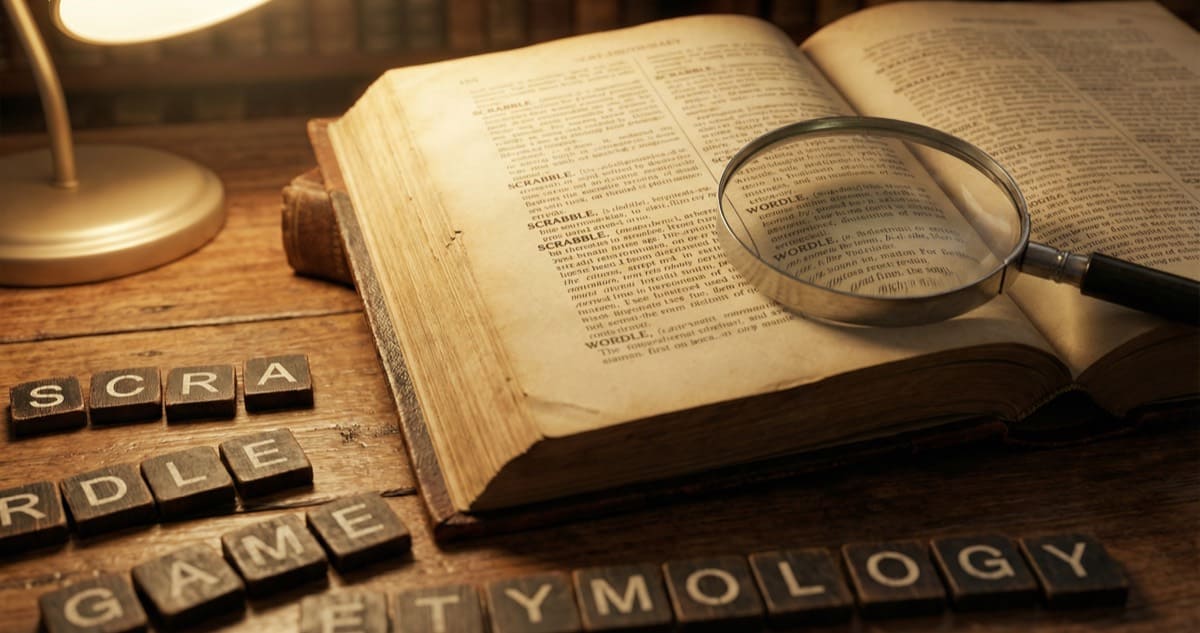
I've spent years building word game tools, but I'd never stopped to ask the obvious question: where do these names actually come from?
Turns out, most word game names aren't marketing inventions. They're rooted in real linguistic history, playful puns, or complete accidents. Some are 100+ years old. Others were named last week. And a few were almost called something hilariously terrible.
Let's dig into the etymology of the games we play every day.
Scrabble: From "Scratch" to Global Phenomenon
Scrabble wasn't always Scrabble. Alfred Mosher Butts, an unemployed architect during the Great Depression, invented the game in 1931 and originally called it Lexiko. When that didn't sell, he renamed it Criss-Cross Words (because it looked like a crossword puzzle).
In 1948, James Brunot bought the manufacturing rights and renamed it again, this time to Scrabble. The word comes from the Dutch word "schrabben," meaning "to scrape" or "to scratch frantically." It's also a real English verb: to scrabble means to scratch, grope, or scramble around.
The name perfectly captures the frantic feeling of rearranging letter tiles on your rack, trying to find anything playable. Butts was an architect by training, and he designed the entire game (including letter distribution and point values) by analyzing letter frequency on the front pages of The New York Times. That frequency analysis is why E gets one point and Z gets 10.
Scrabble didn't take off immediately. It took Macy's stocking it in the early 1950s for sales to explode. By 1954, over four million sets had been sold. Today, you can explore Scrabble's vast vocabulary using tools like our Scrabble word finder.
Wordle: A Love Story and a Pun
Josh Wardle created Wordle in 2020 as a gift for his partner, who loved word games. The name is a pun: "Wordle" = "word" + "Wardle" (his surname).
It's one of the cleverest game names in history because it works on multiple levels. It sounds like "word," it contains "word," and it's also his actual name. Try coming up with a better brand for a word puzzle. You can't.
What most people don't know: Wordle was almost called "Mr. Bugs' Wordy Nugz." Wardle revealed this at a 2024 Figma conference, joking that the game "would not have been successful" with that name. He's probably right.
Wordle launched publicly in October 2021. By January 2022, millions of people were playing daily. The New York Times bought it for "a seven-figure sum" (widely reported as over $1 million but less than $10 million) in early 2022. Not bad for a side project built as a romantic gesture.
Boggle: When Your Brain Gets "Boggled"
Boggle was invented by Allan Turoff and released by Parker Brothers in 1972. The name comes from the verb "boggle," meaning to be confused, amazed, or overwhelmed. That's exactly what happens when you shake that cube and have 90 seconds to find words in a chaotic grid.
The word "boggle" itself dates back to the 1590s, possibly related to "bogle" (a phantom or goblin in Scottish English) or "boggle" (to shy away or hesitate). In modern usage, "mind-boggling" means something so surprising it overwhelms your brain.
Perfect name for a timed word search game, honestly. Your brain gets boggled. The marketing writes itself.
Jumble: From "Scramble" to Daily Newspaper Staple
Jumble was created in 1954 by Martin Naydel, a comic book artist. He originally called it "Scramble", which is straightforward but forgettable. The name was changed to Jumble shortly after, likely because "jumble" better captures the chaotic nature of the scrambled letters.
"Jumble" as a word comes from the 1520s, meaning "to mix in a confused mass." It's imitative — the word sounds like what it describes. Jumble, tumble, rumble, bumble. All these "umble" words convey disorder and chaos.
Jumble appears in over 600 newspapers daily, making it one of the longest-running word puzzles in print. I still remember my dad working through the morning Jumble with his coffee every single day. The cartoon punchline was always terrible, but he loved it anyway.
Bananagrams: "The Anagram Game That'll Drive You Bananas"
This one's recent and completely transparent about its naming. Bananagrams was invented by Abraham Nathanson in 2006. The name comes from the tagline: "The anagram game that will drive you bananas!"
It's a portmanteau of "bananas" and "anagrams." The tiles come in a banana-shaped fabric pouch, which makes the theme inescapable. It's cutesy, but it works. The game sold millions of copies, partly because the name is memorable and the yellow banana packaging is impossible to miss on store shelves.
Nathanson was 76 when he invented it. It proves you can create a hit game at any age if the idea's good and the name sticks.
Crossword: A Typesetting Error Changed History
Arthur Wynne, a journalist from Liverpool, invented the modern crossword puzzle for the December 21, 1913 edition of the New York World newspaper. He called it a "Word-Cross Puzzle."
A few weeks later, a typesetter accidentally transposed the name to "Cross-Word." The error stuck. By the 1920s, it had merged into one word: crossword.
So the name we use today for one of the world's most popular puzzles is literally the result of someone messing up the typesetting. If that compositor had been paying attention, we'd all be doing "word-crosses" instead of crosswords.
Wynne's original puzzle was diamond-shaped with a hollow center. It wasn't until later that crosswords adopted the square grid and black-square symmetry we recognize today. Wynne never patented the format and never profited from his invention, even though crosswords became a global obsession by the 1920s.
Words With Friends: The Social Angle
Words With Friends launched in August 2009, created by Newtoy (acquired by Zynga in December 2010). The name is brilliantly strategic. It's not about the game mechanics (which are basically Scrabble). It's about the social experience.
The name positions the game as a way to connect with people, not just a word puzzle. You're not playing "Mobile Scrabble" or "Word Battle." You're playing with friends. That naming decision probably added millions of users who might not have tried "yet another Scrabble clone."
The name also sidesteps trademark issues with Hasbro's Scrabble while clearly communicating what the game is about. Smart branding that turned a derivative game into a phenomenon.
Anagram: From Ancient Greek to Your Phone
The word "anagram" comes from the Greek "anagrammatismos," meaning "transposition of letters." It's been in English since the 1580s. The Greek roots break down to "ana-" (back, again) + "gramma" (letter).
So an anagram literally means "letters arranged again." It's one of the oldest word puzzle concepts in history, dating back to ancient Greek poets who rearranged names to create poetic nicknames or hide meanings.
I find it fascinating that we're still doing the same thing 2,500 years later, just on smartphones instead of papyrus. The fundamental appeal of rearranging letters hasn't changed. For more on anagram history, check out our article on the complete history of anagrams.
How Names Shape How We Play
Game names aren't just labels. They set expectations and shape player psychology.
Scrabble sounds chaotic and active. You're scrambling, scratching, fighting for points. It primes you for competitive play.
Wordle sounds friendly and approachable. It's not "Word Battle" or "Lexicon Challenge." It's a soft, round-sounding name that says "this is casual, not stressful."
Boggle admits upfront that your brain will be overwhelmed. You accept the chaos before you start.
Words With Friends emphasizes connection over competition. Even when you crush your opponent by 100 points, you're still playing "with" them, not "against" them.
Names matter more than we think. A rose by any other name might smell as sweet, but "Mr. Bugs' Wordy Nugz" probably doesn't become a global phenomenon.
The "Scrabble-Clone" Naming Problem
Hundreds of Scrabble clones exist, but most have terrible names. Word Chums, Word Domination, Word Crossy, Wordfeud, Words of Gold: they all scream "generic mobile game."
Only Words With Friends broke through, and I think the name is 50% of why. It differentiated itself not through gameplay (which is nearly identical to Scrabble) but through positioning: social, casual, friendly. Learn more about the differences in our comparison guide on Scrabble vs. Words With Friends.
If you're building a word game, spend as much time on the name as you do on the mechanics. A great game with a forgettable name dies quietly. A decent game with a brilliant name becomes a phenomenon.
Frequently Asked Questions
Who invented Scrabble?
Alfred Mosher Butts, an American architect, invented Scrabble in 1931 during the Great Depression. He originally called it Lexiko, then Criss-Cross Words. James Brunot bought the rights in 1948 and renamed it Scrabble. Butts determined letter frequency and point values by analyzing newspapers like The New York Times. The game didn't become a hit until Macy's started stocking it in the early 1950s.
Why is Wordle called Wordle and not something else?
Wordle is a pun on creator Josh Wardle's surname combined with the word "word." It was originally going to be called "Mr. Bugs' Wordy Nugz" (Wardle revealed this in 2024), but he wisely chose the cleaner pun instead. The name works because it's memorable, contains the word "word," and references the creator without being egotistical. Good branding turned a lockdown side project into a cultural phenomenon.
What does the word boggle mean?
"Boggle" means to be confused, amazed, or overwhelmed. That's exactly what happens when you shake the letter cube and try to find words under time pressure. The word dates back to the 1590s and possibly relates to "bogle" (a Scottish word for ghost or phantom). The game was invented by Allan Turoff and released by Parker Brothers in 1972. The name perfectly captures the frantic, brain-scrambling experience of timed word searching.
Was crossword originally called something different?
Yes. Arthur Wynne's original puzzle in 1913 was called "Word-Cross." A few weeks later, a typesetter accidentally transposed it to "Cross-Word," and the error became permanent. By the 1920s it merged into one word: crossword. So the name we use today for one of the world's most popular puzzles exists because someone made a typesetting mistake over 110 years ago. History is weird sometimes.
Why is it called Bananagrams?
Bananagrams combines "bananas" and "anagrams" based on the tagline "the anagram game that will drive you bananas." The game was invented by Abraham Nathanson in 2006, when he was 76 years old. The tiles come in a banana-shaped fabric pouch, making the theme impossible to miss. It's a playful portmanteau that clearly communicates what the game is (anagrams) while standing out on store shelves with the bright yellow banana packaging.


